
Brussels, 16 April 2026
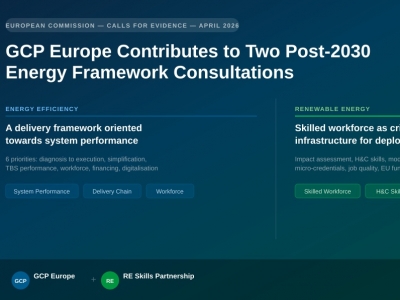
GCP Europe has submitted contributions to two European Commission calls for evidence on the future of EU energy policy: the Post-2030 Energy Efficiency Framework and the Post-2030 Renewable Energy Framework. The first contribution was submitted directly by GCP Europe; the second was submitted through the Renewable Energy Skills Partnership, the EU Pact for Skills Large-Scale Skills Partnership co-coordinated by GCP Europe, EUREC and SolarPower Europe.
Both contributions reflect GCP Europe's conviction that the success of EU energy policy ultimately depends on skilled people, quality implementation, and system-level thinking.
Energy Efficiency: A Delivery Framework Oriented Towards System Performance
In its contribution on the post-2030 energy efficiency framework, GCP Europe calls on the Commission to design future policy more explicitly as a delivery framework — one that translates legal obligations into real works, real system improvements, and real performance gains in buildings.
GCP Europe's core argument is that energy efficiency policy is most effective when it is oriented towards system performance: the real-world outcomes produced by installed systems as a whole, not just the certified performance of individual products. Generation, distribution, emitters, controls, commissioning, maintenance and user interaction all determine whether expected savings materialise in practice.
The contribution outlines six priorities for the future framework:
- Strengthening the link between diagnosis and execution — creating coherent pathways from energy audits to financed works, especially for households and SMEs.
- Simplification that improves implementation — reducing friction in delivery chains without weakening ambition.
- Technical building systems and operational performance — giving more attention to controls, digital tools, commissioning, maintenance, and optimisation over time.
- Retaining and strengthening workforce provisions — requiring Member States to assess and address skills-gap and workforce bottlenecks.
- Delivery-oriented support and financing — designing financing models that account for design, commissioning and optimisation, and that reward measurable efficiency gains.
- Digitalisation as a practical enabler — supporting BACS, AI and digital tools that augment human capability and work in practice, including for SMEs.
HVAC & Water technicians and mechanical contractors are among the key actors through whom energy efficiency becomes operational in buildings. The future framework should better reflect their role.
Renewable Energy: Skills as Critical Infrastructure
Through the Renewable Energy Skills Partnership, GCP Europe also contributed to the post-2030 renewable energy framework consultation. The Partnership's core message is clear: there can be no credible post-2030 renewable energy framework without a skilled workforce treated as critical infrastructure.
The contribution calls on the Commission to:
- Include a systematic workforce dimension in the impact assessment accompanying the legislative proposal, covering projected workforce needs, bottleneck occupations, training capacity, and emerging digital and system-integration skills.
- Strengthen Member State reporting on skills and workforce readiness as part of their renewable deployment planning.
- Recognise that renewable heating and cooling deployment requires dedicated skills measures, including coordinated training and certification efforts for the professions concerned.
- Support modular, competency-based and multi-technology learning pathways alongside full qualifications, covering a system-based approach to technologies from heat pumps to hybrid systems and flexibility solutions.
- Strengthen the role of micro-credentials and certification embedded in robust quality assurance systems.
- Better reflect the link between renewable deployment, job quality and sector attractiveness.
- Mobilise EU financial instruments — including ESF+, Erasmus+, InvestEU, LIFE, the Just Transition Fund and seed funding for Net Zero Academies — to build renewable skills infrastructure at scale.
The Partnership emphasises that workforce planning should be embedded in energy policy design rather than treated as a downstream issue. For subsidiarity reasons, European and national sectoral associations should be empowered in this exercise.
Looking Ahead
The public consultations on both frameworks remain open until 12 June 2026, and GCP Europe will continue to engage as the legislative proposals take shape later this year. Both contributions are available for download below.
